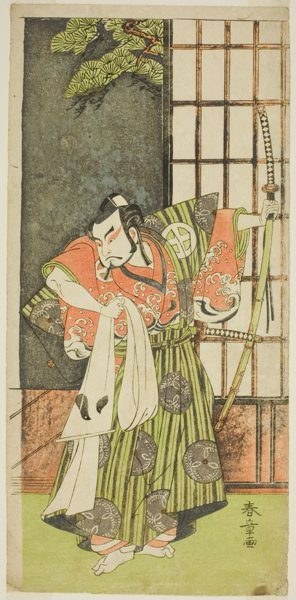
The Actor Otani Hiroji III as Kawazu no Saburo in the Play Myoto-giku Izu no Kisewata, Performed at the Ichimura Theater in the Eleventh Month, 1770
- Accession
- AA.1775.02
- Department
- Asian Art
- Gallery
- AA2 · Ukiyo-e: Actors, Beauties and Legends
- Date
- c. 1770
- Medium
- Color woodblock print; hosoban; from a multisheet composition
- Made in
- Japan
- Original held
- Chicago
Double-Flowered Cherry: Motoura of the Minami Yamasakiya (Minami Yamasakiya uchi Motoura, Yaezakura), from the series "Beauties of the Floating World Compared to Flowers (Ukiyo bijin hana ni yosu)"Next in gallery →
Weaving silk, plate 11 from the series "Silkworm Cultivation (Kaiko yashinai gusa)"
Katsukawa Shunsho's The Actor Otani Hiroji III as Kawazu no Saburo in the Play Myoto-giku Izu no Kisewata, Performed at the Ichimura Theater in the Eleventh Month, 1770, c. 1770, is in the collection of the National Museum of Public Art, where it hangs in Gallery AA2, Ukiyo-e: Actors, Beauties and Legends (1760–1870), in the Department of Asian Art.
Color woodblock print; hosoban; from a multisheet composition. Made in Japan. The original is held in Chicago. Catalogued as accession AA.1775.02.
The collection holds eleven works by Katsukawa Shunsho: Ichikawa Danjūrō V as a Skeleton, Spirit of the Renegade Monk Seigen, and Iwai Hanshirō IV as the Cherry Princess, in “Flower of Edo: An Ichikawa Saga” (Edo no Hana Mimasu Soga), Actors Segawa Kikunojô II as Reizei, Ichikawa Komazô I as Suruga no Hachirô, and Ichikawa Yaozô II as Tada no Kurando in “The Genji Clan Now at Its Zenith” (“Ima o sakari suehiro Genji”), Weaving silk, plate 11 from the series "Silkworm Cultivation (Kaiko yashinai gusa)", The Actor Nakamura Matsue I as Kasaya Sankatsu (?) in the Play Hana no Gosho Konegen Butai (?), Performed at the Nakamura Theater (?) in the Eighth Month, 1772 (?), The Actor Nakamura Noshio I in an Unidentified Role and The Actor Arashi Hinaji I as Hananoi in the Play Gosho-zakura Horikawa Youchi, Performed at the Ichimura Theater in the Fourth Month, 1773 and others.